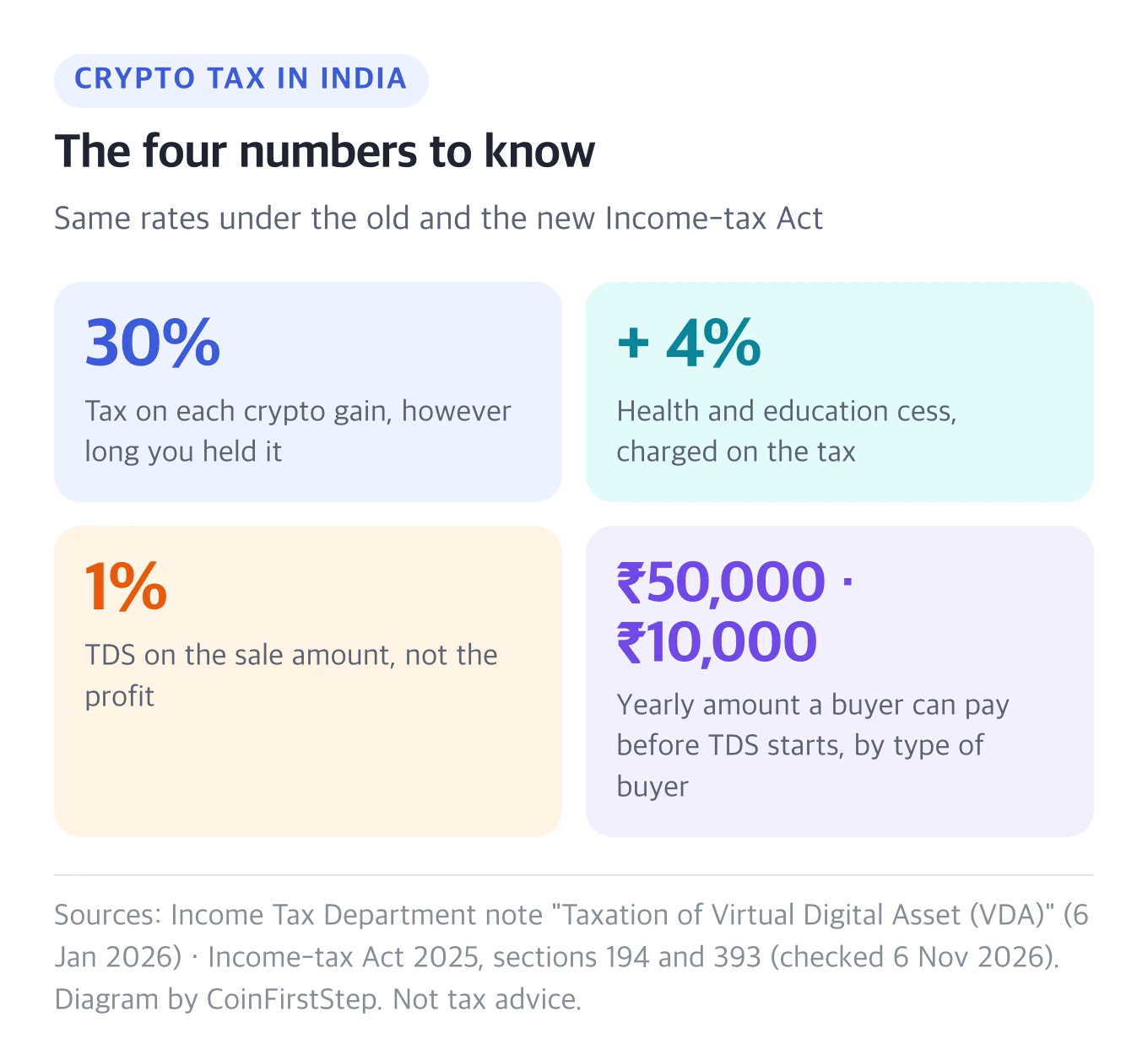
Hi, this is CoinFirstStep. If you trade on Binance from India, two numbers matter at tax time: a flat 30% tax on your crypto gains and a 1% TDS on crypto sales. Every profitable crypto sale or swap is taxed at 30% plus 4% cess, with no deduction except what you paid for the crypto, and losses can't reduce your gains or your other income. The 1% TDS is taken on sales above a yearly limit and counts toward your final tax.
This is general information, not tax advice, so check your own case with a chartered accountant.
20% commission rebate
Referral link: you get a 20% commission rebate on your trading fees (disclosure).
At a glance
| Tax on gains | 30%, plus 4% cess, plus surcharge on high incomes |
|---|---|
| Deductions | Only the cost of buying the crypto |
| Losses | Can't be set off against any income or carried forward |
| TDS | 1% of the sale amount, once the buyer's yearly payments pass a limit |
| Reporting | Schedule VDA in ITR-2 or ITR-3 |
| Law | Income-tax Act 2025 from 1 April 2026 (the 1961 Act before that) |
1. Binance crypto tax in India: the short answer
Binance crypto tax in India follows the same rules as any other crypto platform, because the tax applies to you, not to the exchange. India treats crypto as a virtual digital asset (VDA). Since April 2022, income from transferring a VDA has been taxed at a flat 30%, and since July 2022, a 1% TDS has applied to VDA sales.
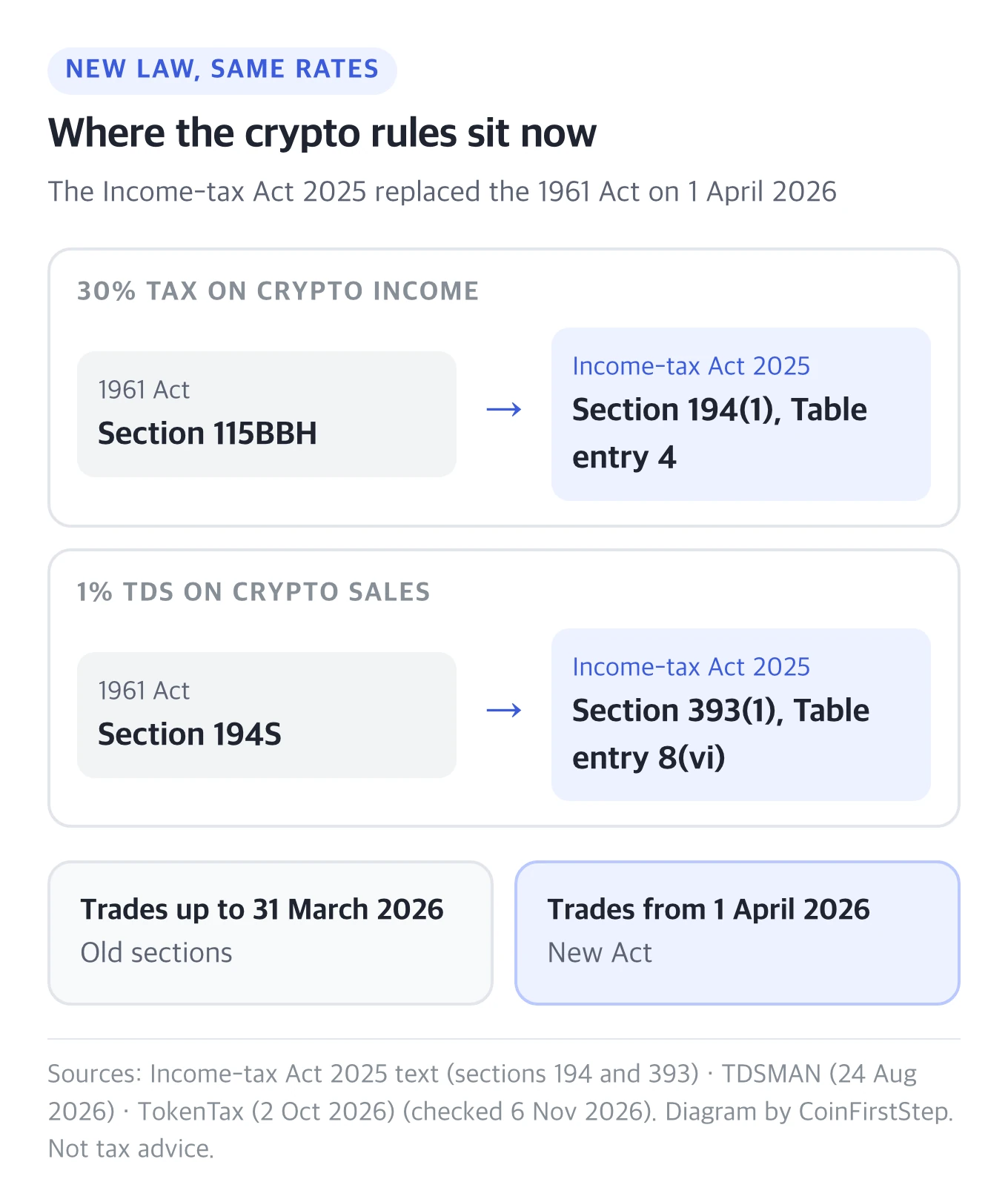
From 1 April 2026, the new Income-tax Act 2025 replaced the 1961 Act. The rules moved to new section numbers, but the rates stayed the same, and Budget 2026 didn't change them. The new Act also calls the year a tax year: trades from 1 April 2026 to 31 March 2027 fall in tax year 2026–27.
2. The 30% tax on crypto gains
Your gain on each sale is the sale amount minus what you paid for that crypto. That gain is taxed at 30%, and 4% cess is added on the tax. A surcharge is also added if your total income is above ₹50 lakh.
Three rules make crypto tax stricter than tax on shares:
| Only buying cost counts | You can't deduct trading fees, internet costs or any other expense |
|---|---|
| No loss set-off | A loss on one coin can't reduce the gain on another, your salary or any other income |
| No carry-forward | This year's crypto loss can't reduce next year's tax |
It also doesn't matter how long you held the coin. A coin held for a day and a coin held for five years are taxed at the same 30%.
3. The 1% TDS on crypto sales
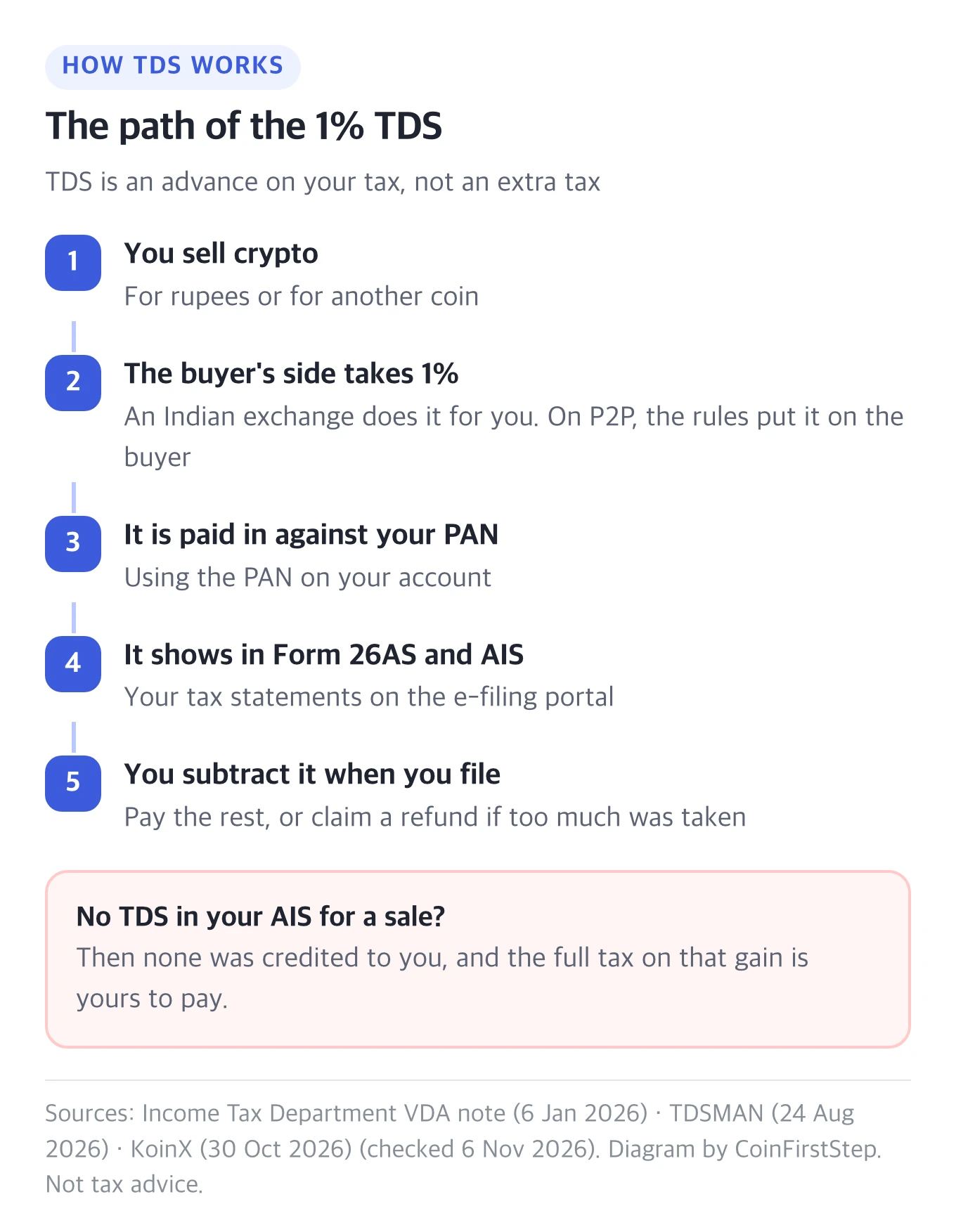
TDS (tax deducted at source) is 1% of the sale amount, not the profit. It is taken when crypto is sold and paid in against the seller's PAN. That's the PAN you link during Binance KYC; the step-by-step sign-up guide shows where.
When TDS starts. The limit depends on the buyer, not on you. If the buyer is an individual or HUF with no business income, or with a small business (turnover up to ₹1 crore, or professional receipts up to ₹50 lakh, in the previous year), TDS starts once their crypto payments in the year pass ₹50,000. For other buyers, it starts after ₹10,000. Some blogs say the new Act removed these limits. It didn't: they sit in the Act's no-deduction table.
Who deducts it. When a trade goes through an exchange, the tax department's 2022 guidelines (CBDT Circular 13/2022) let the exchange that pays the seller deduct it, and Indian exchanges do this for you. In a peer-to-peer trade, where the buyer pays the seller directly, the duty is on the buyer of the crypto. Binance P2P works this way: you pay the seller's bank account or UPI yourself. If you buy USDT on Binance P2P, that buyer is you, so keep a running total of what you pay on P2P in the tax year. If you're an individual with no business income or only a small one, no TDS is due from you below ₹50,000. Before your purchases pass that limit, ask a chartered accountant how to pay it (an individual buyer doesn't need a TAN; the form is Form 141 under the new Act). If the seller has no PAN on record, TDS can be taken at 20%.
The common slip here is counting only what you sell. The ₹50,000 limit counts what you pay as a buyer, so a year of small P2P USDT purchases can pass it without any single big trade.
What happens to it. TDS is not an extra tax. It shows in your Form 26AS and Annual Information Statement (AIS), and you subtract it from your final tax when you file. If more was taken than you owe, you claim the difference back as a refund.
This guide covers residents of India. If you sell to a non-resident, a different TDS rule applies.
4. What counts as a taxable crypto trade
| Buy crypto with rupees and hold it | No, not until you sell or swap it |
|---|---|
| Sell crypto for rupees, including on P2P | Yes, at 30% on the gain |
| Swap one coin for another, such as BTC for USDT | Yes, each swap is a transfer |
| Spend crypto on goods or services | Yes, it's a transfer too |
| Receive crypto gifts from non-relatives | Yes, at slab rates, once gifts pass ₹50,000 in a year (relatives' gifts are exempt) |
| Move crypto between your own wallets | Generally no, because you still own the same crypto |
On Binance, most trades are against USDT, so selling a coin for USDT is already a taxable transfer, even before you change USDT back to rupees.
Futures, staking, airdrops and mining aren't covered by the table above. The Act doesn't spell out how crypto futures are taxed, and tax professionals disagree on whether futures profits fall under the 30% VDA rule or count as business income. If you trade Binance Futures or earn rewards, ask a chartered accountant before you file.
5. Worked example
Say you made two trades in one year as a resident of India, with no other crypto trades and no surcharge:
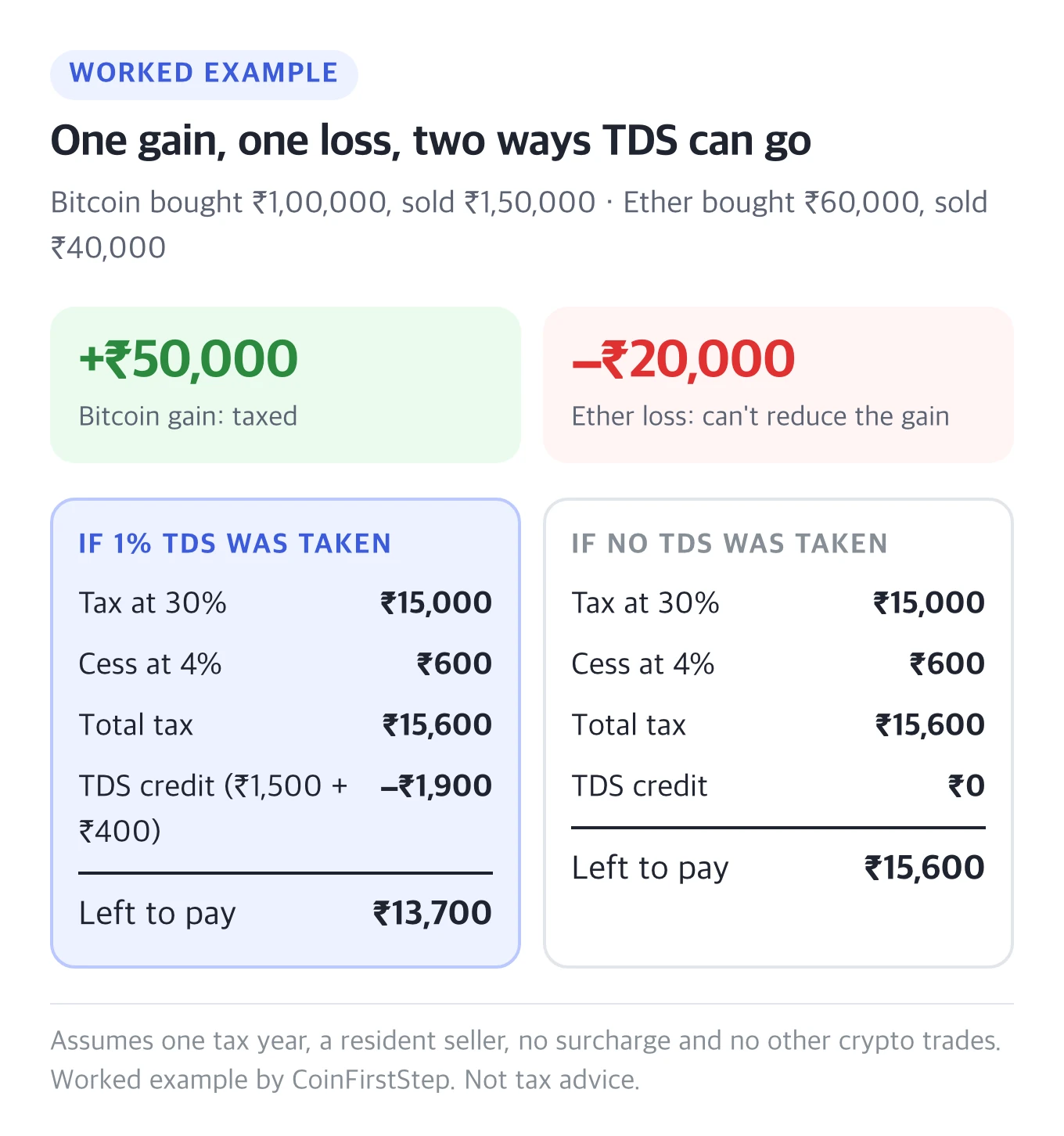
You bought Bitcoin for ₹1,00,000 and sold it for ₹1,50,000, a gain of ₹50,000. You bought Ether for ₹60,000 and sold it for ₹40,000, a loss of ₹20,000.
The Ether loss can't reduce the Bitcoin gain, so the taxable gain is ₹50,000. Tax at 30% is ₹15,000, and 4% cess on that is ₹600, for ₹15,600 in total.
If 1% TDS was taken on both sales, that's ₹1,500 on the Bitcoin sale and ₹400 on the Ether sale, even though the Ether sale made a loss. Then ₹15,600 − ₹1,900 = ₹13,700 is left to pay. If no TDS was taken, the full ₹15,600 is yours to pay.
To try your own numbers, use the India crypto tax calculator. It applies the same rules, sale by sale.
6. What to keep and report
Keep a record of every trade. For each sale or swap, note the date you bought, the date you sold, what you paid and what you got. Your Binance trade history is the easiest place to start, so download it before the end of each financial year.
Report it in your return. Crypto income goes in Schedule VDA. For financial year 2025–26 (the return filed in 2026), that's Schedule VDA in ITR-2 or ITR-3. ITR-1 and ITR-4 can't be used for crypto income. Enter each transfer with its dates, cost and sale amount, then claim the TDS shown in your Form 26AS or AIS.
Missed the due date? For financial year 2025–26, a belated return can still be filed until 31 December 2026 (or before your assessment is completed, if that comes first), usually with a late fee. Check the e-filing portal for the exact rules for your case.
▣ Check your AIS before you file
Log in to the income tax e-filing portal, open your Annual Information Statement (AIS) and look at the TDS information. It shows which crypto sales had TDS paid in against your PAN, and only those amounts can be credited.
Exchanges have to report too. Under Section 509 of the new Act (Section 285BAA of the old one), crypto platforms named in the rules must report their users' crypto transactions to the tax department, and Budget 2026 added a daily penalty for platforms that don't. Keep your own records either way.
The Income Tax Department has a one-page note on VDA tax. It still cites the old section numbers: Taxation of Virtual Digital Asset (VDA).
Crypto prices are volatile, and you can lose money. This is an explainer, not tax or investment advice. Tax rules can change, so confirm the current rules or ask a chartered accountant before you file.
7. Binance TDS and crypto tax in India FAQ
Does Binance deduct 1% TDS?
We couldn't find an official Binance statement on this. Check your AIS as described in section 6, What to keep and report. On Binance P2P, the rules put the duty on the buyer.
Can I set off a crypto loss against my salary?
No. See the rules in section 2, The 30% tax on crypto gains.
Is the 30% tax only on profit?
Yes. The 30% is on the gain, meaning the sale amount minus what you paid.
Is swapping BTC for USDT on Binance taxable?
Yes. A swap is a transfer of one crypto for another, so any gain on the coin you gave up is taxed at 30%.
Is Binance legal in India?
Binance is registered with FIU-IND as a reporting entity, so it can serve users in India. See Is Binance legal in India?.
That covers how Binance crypto tax in India works: the 30% tax, the 1% TDS and what to report.
Thanks for reading!