Hi, this is CoinFirstStep. A Binance P2P bank account freeze in India usually happens when the rupees someone sends you turn out to be money from a fraud. The victim reports it on 1930 or cybercrime.gov.in, police trace the money, and every bank it passed through can be asked to put a hold on it. You can't remove the risk completely, but paying and receiving only in your own name, with matching names on both sides, lowers it.
This guide explains why it happens, what the different kinds of block mean, a checklist for every trade, and what to do step by step if your account is frozen. This is general information, not legal advice.
20% commission rebate
Referral link: you get a 20% commission rebate on your trading fees (disclosure).
At a glance
| Main cause | Rupees from a fraud passing through your account |
|---|---|
| Who it hits most | The person who receives rupees, usually a seller |
| Best protection | Your own account, matching names, records of every order |
| Binance's role | It can't unfreeze a bank account |
| If it happens | Ask your bank in writing, collect records, contact the investigating officer |
1. Why honest P2P traders get their accounts frozen
Binance says this happens in its own help pages: some P2P sellers reported that their bank accounts were frozen after trading with certain buyers. The pattern behind most cases is the same.
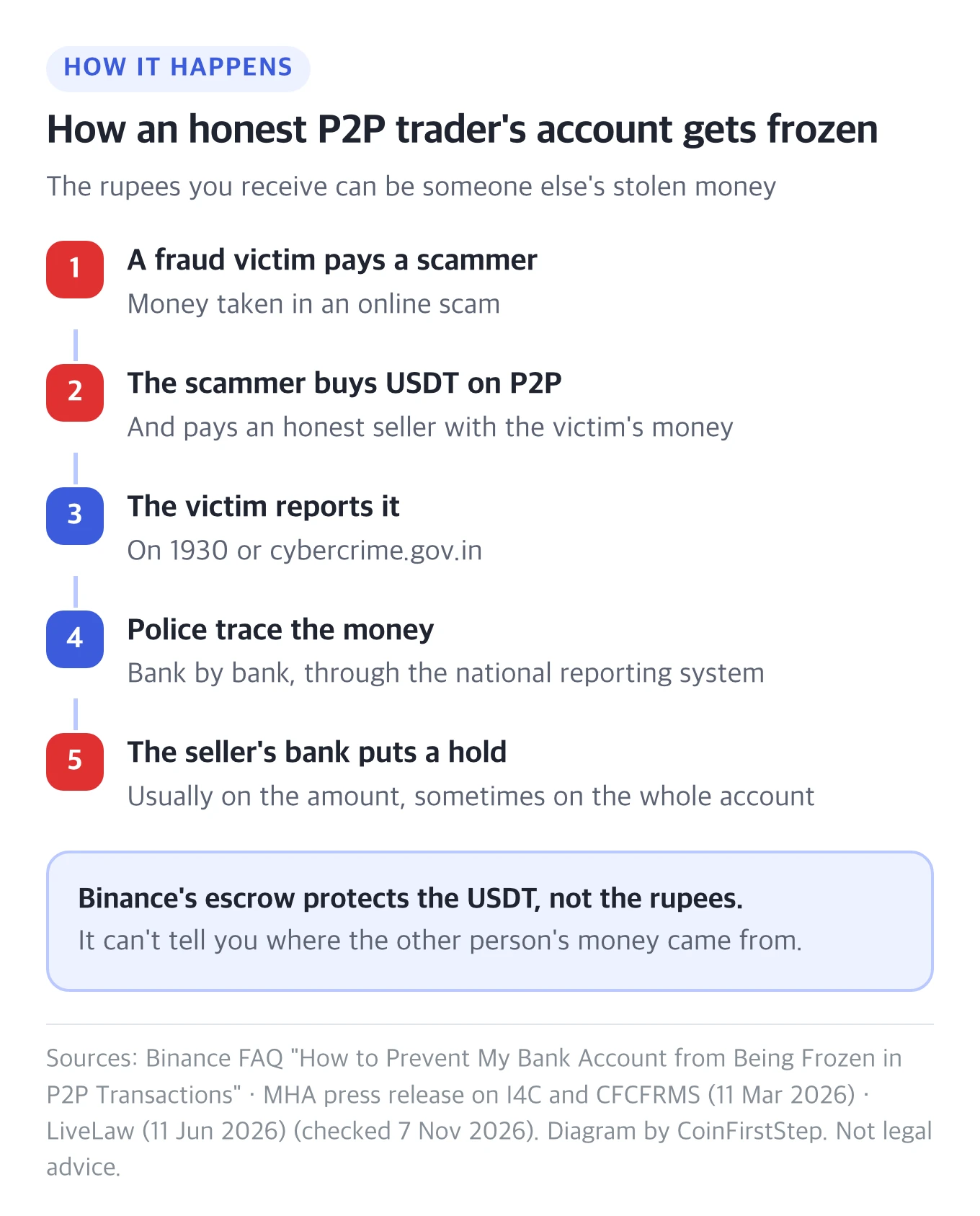
The scammer uses stolen rupees to buy USDT from an honest seller, then moves the USDT away. The victim reports the fraud on the national helpline 1930 or at cybercrime.gov.in. Through the Home Ministry's Citizen Financial Cyber Fraud Reporting and Management System, which is connected to banks, a hold (lien) can be marked on the money at each bank it touched. The honest seller often finds out only when a payment fails.
Binance's escrow holds the seller's USDT during the order. It can't show where the buyer's rupees came from, and stronger KYC on Binance doesn't change that.
2. Lien, debit freeze, full freeze: what each means
"Frozen" can mean different things, and the difference matters when you talk to your bank.
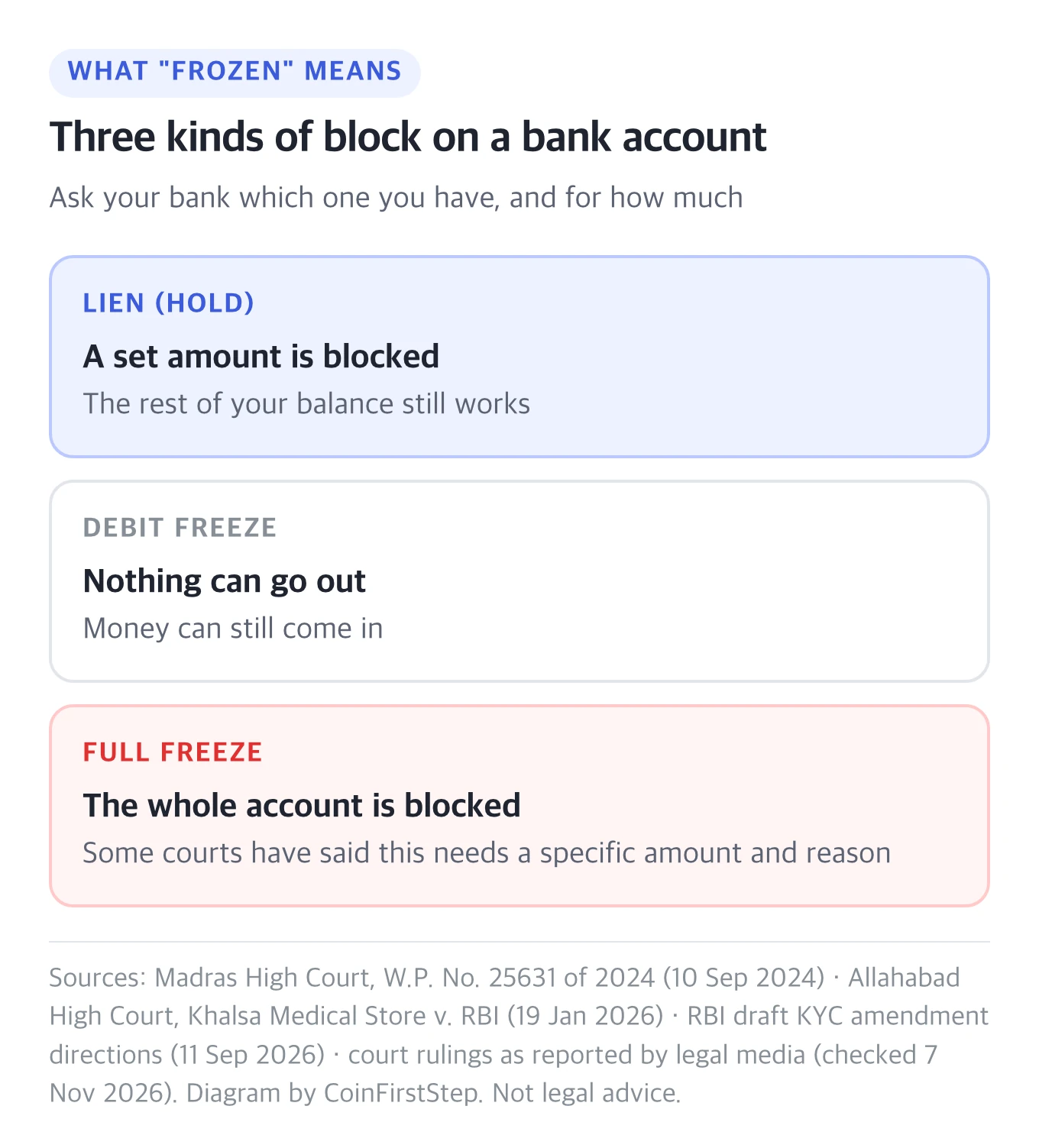
Police notices usually cite Section 106 of the Bharatiya Nagarik Suraksha Sanhita (BNSS), the power to seize property linked to a crime, which replaced Section 102 of the old CrPC in July 2024, so you may see either number. Courts don't all read it the same way: in January 2026 the Delhi High Court said this section doesn't allow a debit freeze, and that freezing needs a magistrate's order under Section 107.
Indian courts have pushed back on blanket freezes. In September 2024, in a case about suspected crypto-fraud money, the Madras High Court said police can't freeze a whole account without stating the amount and period, and released everything except a lien close to the disputed sum. In January 2026, the Allahabad High Court said police need a reasonable belief, not just suspicion, that the bank should receive a copy of the FIR or complaint, that only the specific amount can be held, and that a magistrate must be told within 24 hours.
That isn't a guarantee. In July 2026 the Kerala High Court refused to release an account it found had been opened to move fraud money, and ordered police to investigate the account holder. So ask your bank exactly what kind of block you have and for how much.
3. Who is most at risk: buyers or sellers?
Most reported freezes hit the account that receives rupees, which on P2P is usually the seller of USDT. When you buy USDT, you're the one sending rupees, so your exposure is different, but it isn't zero.
| Buying USDT, paying from your own account | Lower. Keep your records |
|---|---|
| Seller asks you to pay "another account" | High. Cancel and report it in the order chat |
| Selling USDT, sender's name doesn't match | High. Refund to the same account and cancel |
| Selling USDT, sender's name matches | Lower, not zero. Check in your bank app and keep records |
| Someone offers to unfreeze your account for a fee | High. Don't pay. Go through your bank and the police |
Most buyers become sellers later, when they sell USDT back for rupees. That's when the selling half of the checklist in section 4, Checklist before every P2P trade, matters most.
4. Checklist before every P2P trade
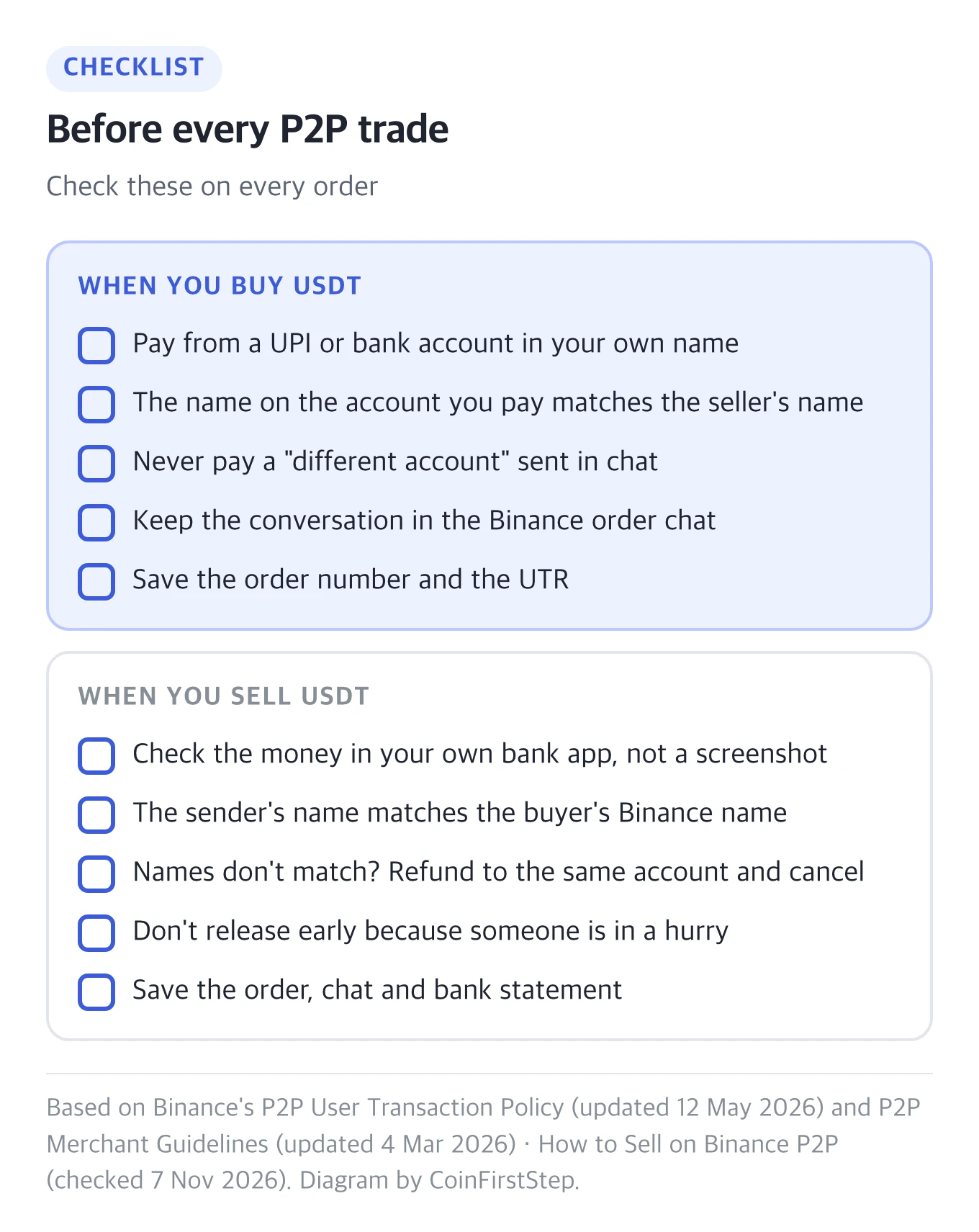
These come from Binance's own P2P rules. Binance doesn't support payment methods that aren't in your verified name, and using one suspends your P2P access for at least 7 days. Its merchant guidelines say that if the payer's bank details don't match the buyer's verified name, you shouldn't release the crypto; you can refund the payment instead. When you sell, Binance also tells you to confirm the money in your bank account or wallet itself, not from an SMS or email alone.
Of all of these, the name check is the one I never skip. If you're buying for the first time, how to choose a seller on Binance P2P shows where to see the seller's details before you pay.
5. If your account is frozen: what to do, step by step
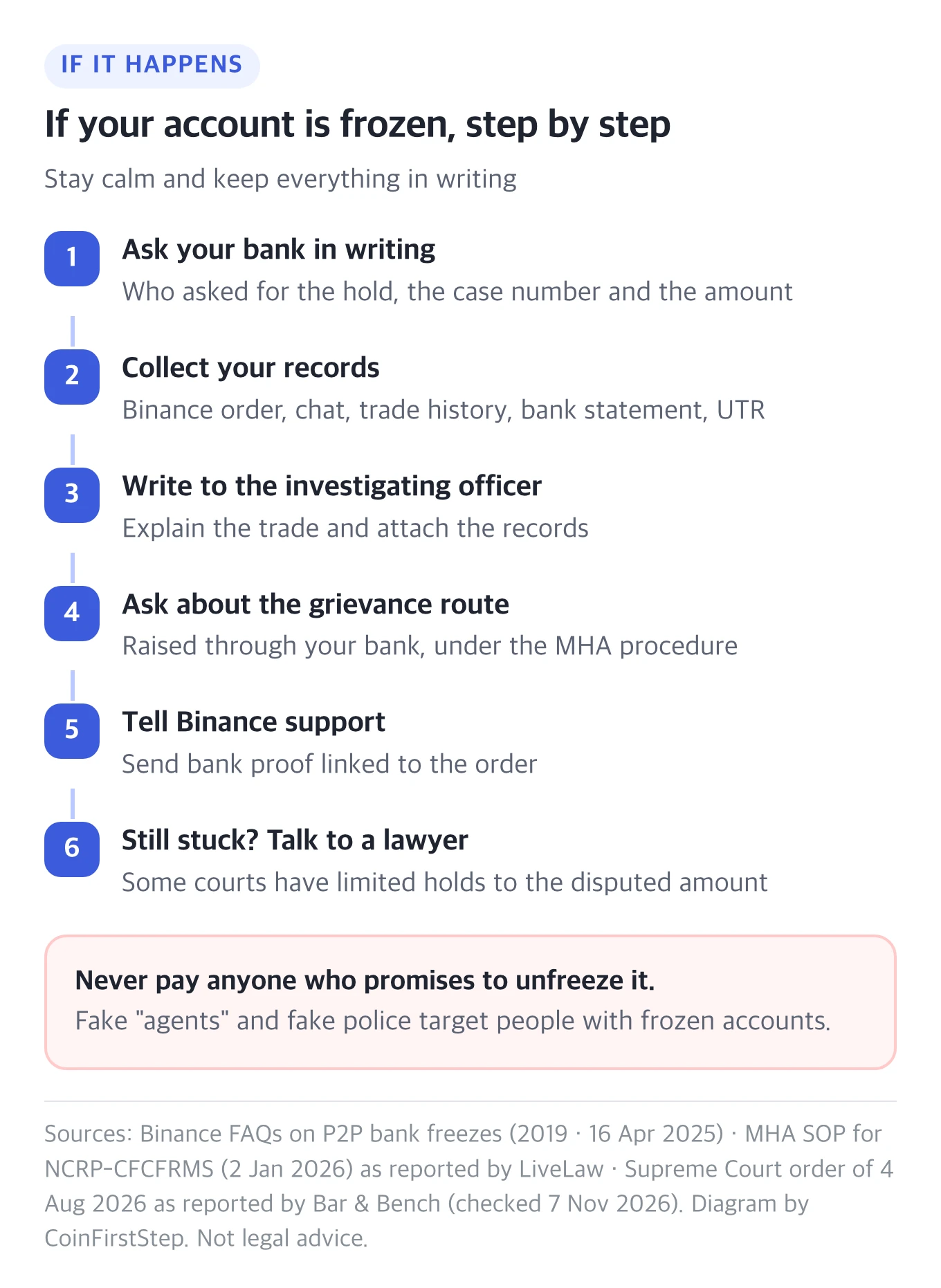
Start with your bank, in writing. Ask which police station or cyber cell asked for the hold, the complaint or case number, and the amount. The branch may not have these details at hand, so a written request helps.
Collect your records. Your Binance order number, the P2P Order Receipt (Binance says you can download it from your account to show your bank), the chat, your trade history, your bank statement and the UPI reference number (UTR) show the trade was a normal sale.
Contact the investigating officer. Send a short written explanation with the records. Keep copies of everything you send.
Ask about the grievance route. The Ministry of Home Affairs issued a standard procedure for cyber-fraud holds in January 2026. It includes a grievance process: you raise it with your bank, and the bank passes it on through the national cyber-fraud system. If your bank doesn't respond, escalate to its grievance or nodal officer.
Tell Binance support. Binance's help page on bank freezes says it can look into the order and talk to the other side if you send bank proof linked to that order (a video recorded on a second device; screen recordings aren't accepted). Its merchant rules also say police can request information from Binance through its law enforcement request system. Binance can't unfreeze a bank account; only your bank and the authorities can.
Still stuck? A lawyer can tell you whether to approach a court. Getting a hold lifted can take weeks or months.
6. What changed in 2026
| January 2026 | Home Ministry procedure for cyber-fraud holds and grievances |
|---|---|
| January 2026 | Allahabad High Court: only amount-specific liens, magistrate told within 24 hours |
| August 2026 | Supreme Court tells the RBI to prepare a procedure for mule-account holds |
| September 2026 | RBI draft: holds on suspected mule accounts up to 60 days, with notice to the customer |
The RBI draft, released on 11 September 2026, covers holds that banks place themselves when their monitoring flags a suspected mule account. This is separate from the police route in section 1, Why honest P2P traders get their accounts frozen. It proposes that banks tell customers the reason, the removal process and an officer's contact details, give them 20 days to explain, and hold a whole account only as a last resort. Comments closed on 2 October 2026, and no final rules had been published as of 7 November 2026, so check the RBI website before relying on it.
Crypto prices are volatile, and you can lose money. This is an explainer, not legal or investment advice.
7. Binance P2P bank account freeze FAQ
Can my account be frozen if I only buy USDT?
It's less common, but it can still happen if you pay an account linked to fraud, so pay only the seller's own account.
Will Binance unfreeze my bank account?
No. Only your bank and the authorities can lift it. What Binance can do is in section 5, If your account is frozen: what to do, step by step.
Is a lien the same as a freeze?
No. A lien holds a set amount, and the rest of your balance still works. A debit freeze stops all money going out.
How long does a freeze last?
There's no single answer; people report anything from weeks to months. The RBI's 2026 draft proposes a 60-day limit for holds that banks place on suspected mule accounts, but it wasn't final as of 7 November 2026.
Someone says they can unfreeze my account for a fee. Should I pay?
No. People who promise this are often scammers. Go through your bank and the police.
That covers why a Binance P2P bank account freeze happens and what to do about it. For the basics of buying, see how to buy USDT on Binance with INR, and if you don't have an account yet, the step-by-step sign-up guide covers KYC.
Thanks for reading!