Hi, this is CoinFirstStep. Is Binance legal in India? Yes. Using crypto is not banned in India, and Binance is registered with India's Financial Intelligence Unit (FIU-IND) as a reporting entity. But crypto is not legal tender, there is no dedicated crypto law, and your gains are taxed.
Below are what FIU registration means, the key dates from 2020 to 2026, and the KYC, transfer and tax rules you'll meet as a user. This is general information, not legal advice.
20% commission rebate
Referral link: you get a 20% commission rebate on your trading fees (disclosure).
At a glance
| Is crypto banned in India? | No |
|---|---|
| Is Binance registered? | Yes, with FIU-IND as a reporting entity (2024) |
| Is crypto legal tender? | No |
| Is there a crypto law? | Not yet. Crypto is covered by tax and anti-money-laundering rules |
| What you need | KYC with your PAN, and tax on your gains |
1. Is Binance legal in India? The short answer
In written replies to Parliament in July 2025 and again in February 2026, the government said crypto assets are not regulated in India. What the law does require is that crypto platforms serving Indian users register with FIU-IND and follow anti-money-laundering (AML) rules. Binance did that in 2024.
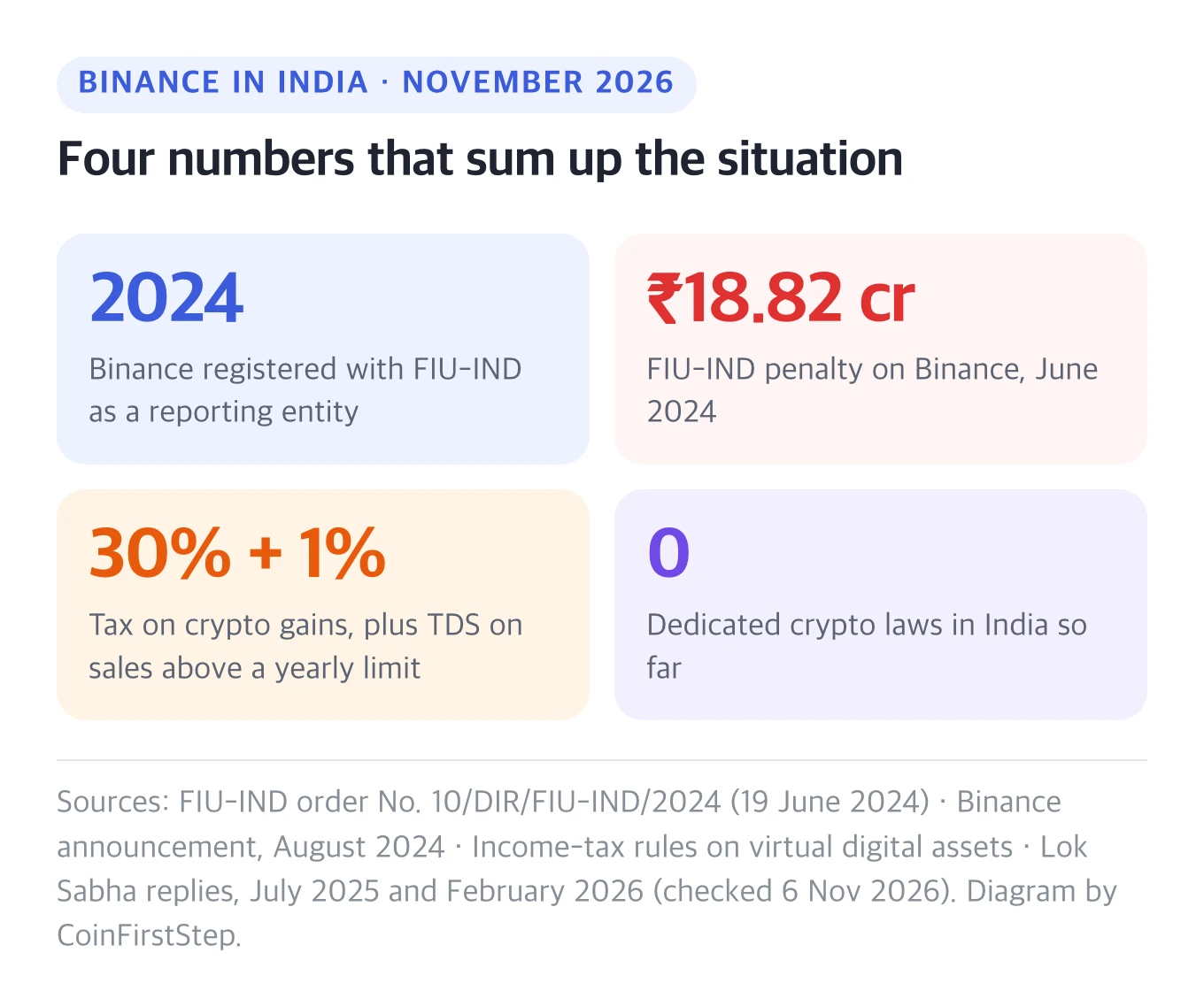
For you as a user, two more rules apply: you complete KYC, and you pay tax on your crypto gains. The sections below explain each part.
2. What FIU registration means
In March 2023, India brought crypto businesses under the Prevention of Money Laundering Act (PMLA). Any business that exchanges crypto for rupees or other crypto, transfers it, or holds it for you became a reporting entity.
A reporting entity must register with FIU-IND, verify the identity of its users, keep records of transactions and report suspicious ones. These are the same kind of duties that banks and other financial firms have under the PMLA.
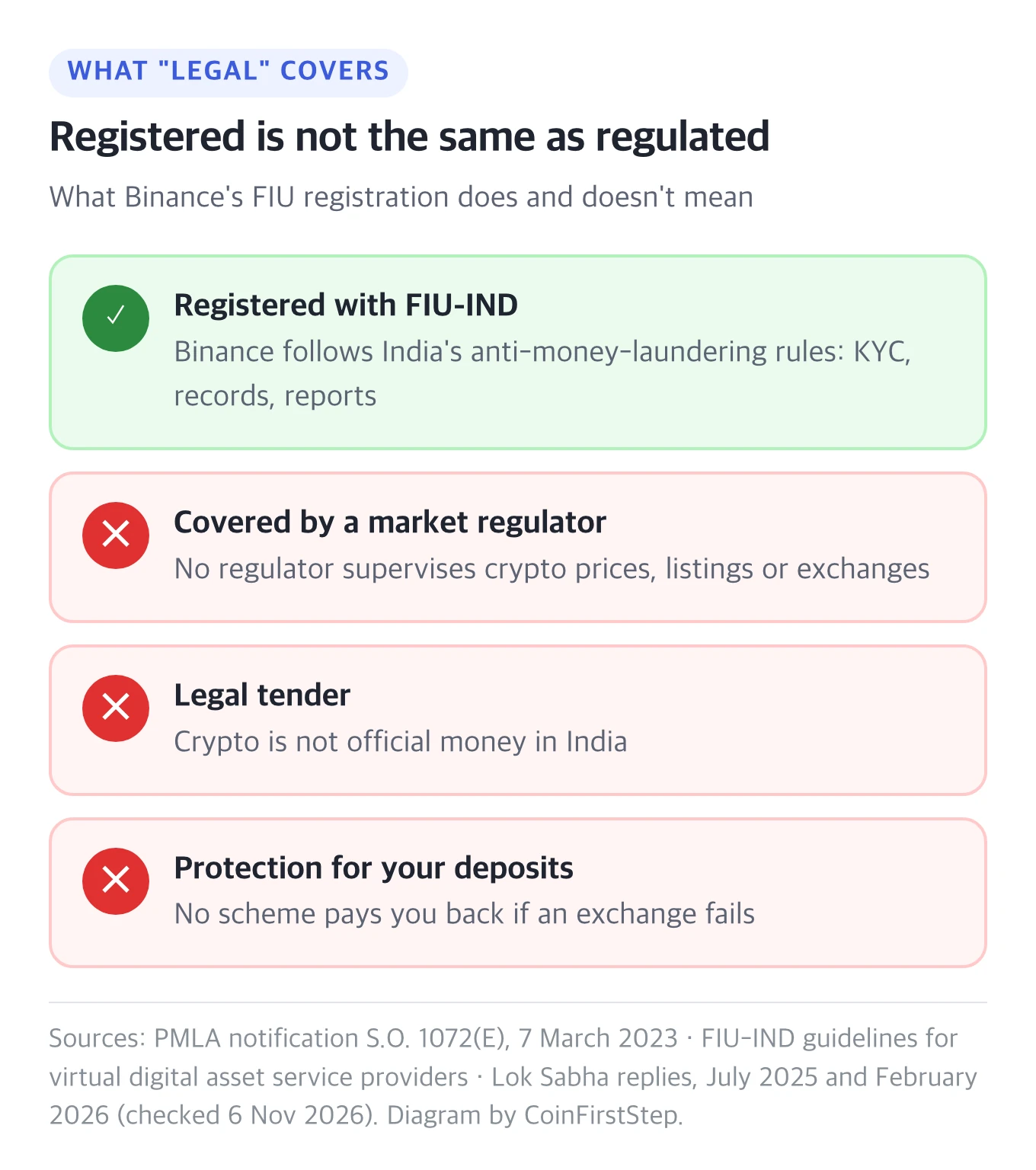
So FIU registration is about money laundering. FIU-IND is an anti-money-laundering agency, not a market regulator. It doesn't supervise prices or listings, and it doesn't protect your money if something goes wrong.
3. Binance in India: key dates
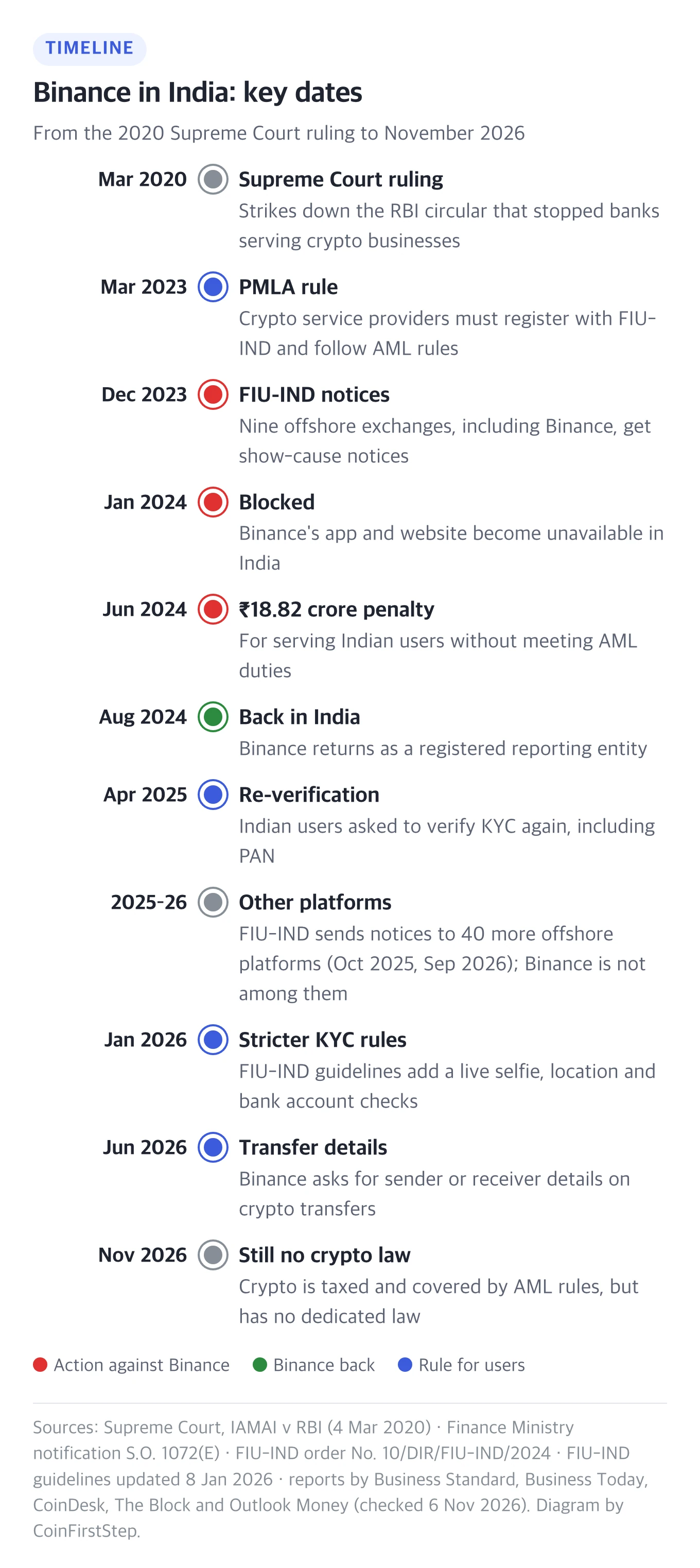
The trouble started with a notice. On 28 December 2023, FIU-IND sent notices to nine offshore exchanges, Binance among them, for serving Indian users without following PMLA rules. In January 2024, Binance's app was removed from Indian app stores and its website was blocked in India.
The biggest event was the penalty. FIU-IND's order of 19 June 2024 fined Binance ₹18.82 crore for serving Indian users without meeting its AML duties. The order itself is public on the FIU-IND website. Binance had registered with FIU-IND in May 2024, before the order. After the penalty was paid, Binance announced on 15 August 2024 that its website and app were fully available to Indian users again.
Since then, FIU-IND has kept acting against offshore platforms that aren't registered: 25 got notices in October 2025 and 15 more in September 2026, along with requests to take down their apps and websites. Binance was not on either list. That's why other exchange apps can disappear from app stores in India while Binance stays available.
Before I move money to any exchange from India, I check two things first: has its name appeared in an FIU-IND notice, and is its FIU-IND registration backed by something other than the exchange's own word, such as an FIU-IND order or several news reports? A big global brand name is not the same as registration: the September 2026 list included platforms such as Pionex, WhiteBIT and XT.com.
4. What it means for you
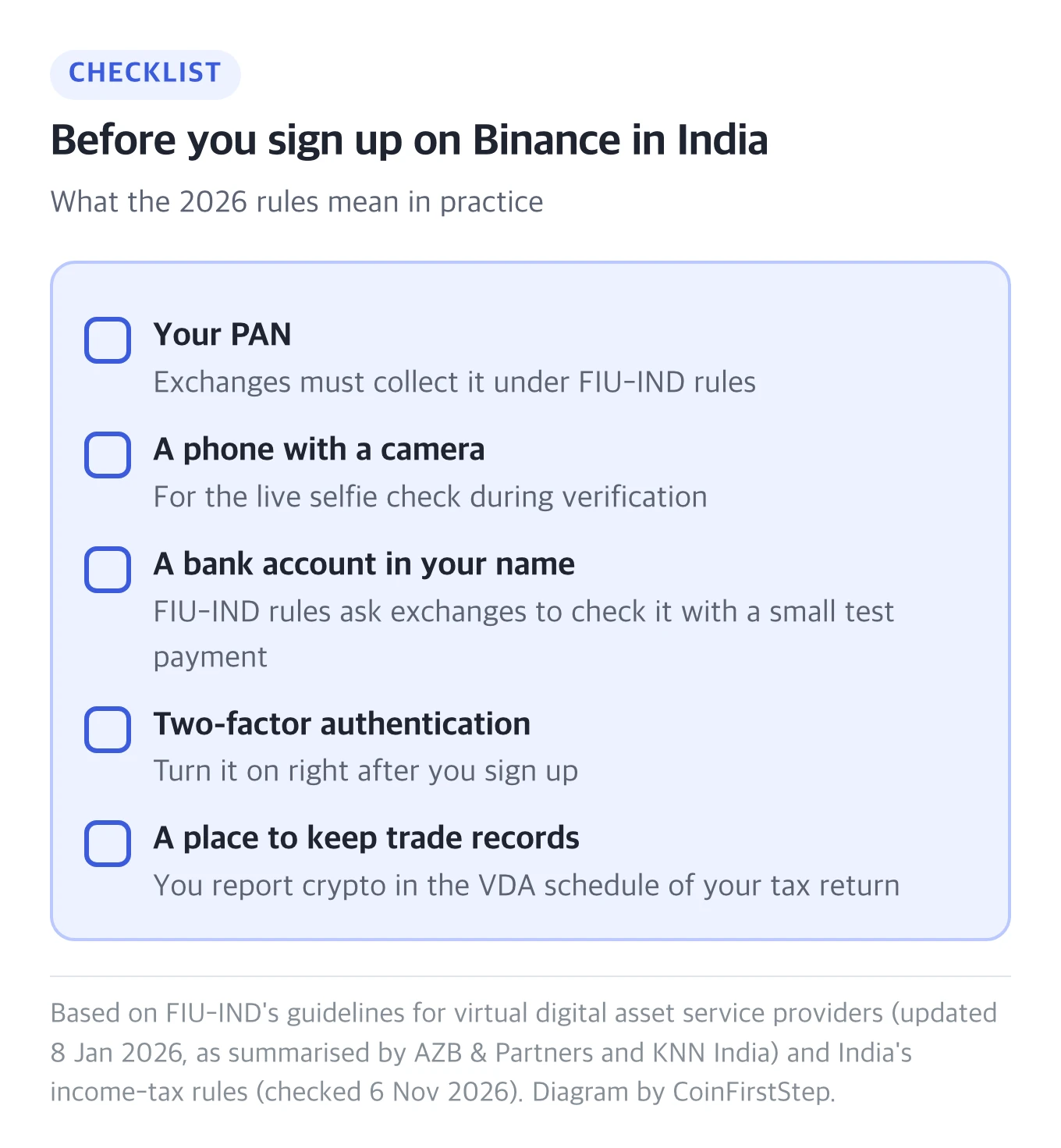
KYC with your PAN, a selfie and a bank check. Because Binance is a reporting entity, it has to verify who you are. FIU-IND's guidelines, updated on 8 January 2026, ask crypto exchanges to collect your PAN, take a live selfie, record where and when you sign up, confirm your phone and email with a code, and verify your bank account with a small test payment. Binance had already asked all Indian users, new and existing, to re-verify with their PAN in April 2025. Have your PAN card ready, and check that the name on your PAN matches the name on your bank account before you start. The full steps are in the sign-up and KYC guide.
Extra details when you send crypto. Since 22 June 2026, Binance has asked Indian users for the sender's details when crypto arrives from another exchange or wallet: name, PAN or national ID, and address. When crypto goes out, it asks for the receiver's name, country and city. If you're sending to your own account on another exchange, you only name that exchange. This follows the Travel Rule, a global anti-money-laundering rule that makes exchanges pass sender and receiver details along with a transfer. Trading on Binance itself isn't affected.
Tax on your gains. India taxes crypto gains at a flat 30% plus 4% cess, and a 1% TDS applies to crypto sales above a yearly limit. Losses can't be set off against any other income, not even gains on another coin, and can't be carried forward. You report crypto in the VDA schedule of your income tax return. In a February 2026 reply to Parliament, the Finance Ministry said the tax department contacts people whose crypto trades are missing from that schedule. The Binance crypto tax guide works through an example.
Rupees through P2P. The usual way Indian users add rupees is Binance P2P: you buy USDT from another user and pay them by UPI or bank transfer. See how to buy USDT with INR.
5. What "legal" doesn't mean
| Official money? | No. Crypto is not legal tender, so no one has to accept it as payment |
|---|---|
| A crypto law? | Not yet. A government discussion paper has been promised since 2024, and reports in April 2026 said it was put on hold again. A parliamentary finance committee is still studying crypto |
| RBI support? | No. In July 2026, the RBI told that committee crypto should not be given legal status |
| Deposit protection? | No. FIU registration covers AML duties, not the safety of your funds |
Rules can change, so check the current position before you sign up or move money, and only use money you can afford to lose.
Crypto prices are volatile, and you can lose money. This is an explainer, not legal or investment advice.
6. Is Binance legal in India? FAQ
Is Binance banned in India?
No. It was blocked from January to August 2024 and has been available again since it registered and paid the penalty (section 3, Binance in India: key dates).
Can I get into trouble for using Binance in India?
Using a registered exchange isn't against the law. What the rules ask of you is KYC with your PAN and reporting your gains in the VDA schedule of your tax return (section 4, What it means for you).
Is it safe to keep money on Binance in India?
No deposit-protection scheme covers it (section 5, What "legal" doesn't mean). Turn on two-factor authentication, use a strong password and keep only what you need on the exchange. See how to set up Binance 2FA.
Can I use Binance without PAN?
Plan on having it. KYC with your PAN is required (section 4, What it means for you).
Why does Binance ask who sent me crypto?
It's the Travel Rule check on transfers (section 4, What it means for you), not a sign that something is wrong with your account.
That covers whether Binance is legal in India and what FIU registration means for you.
Thanks for reading!