Hi, this is CoinFirstStep. Open interest in crypto futures is the number of contracts that are still open at a given moment. It rises when new positions open and falls when positions close or are liquidated, so it shows how many positions are in the market, not which way the price will go.
This guide explains how open interest differs from volume, why the unit can change the story, how the common price and open interest table held up on a month of real Binance data, and how to read one real drop step by step.
20% commission rebate
Referral link: you get a 20% commission rebate on your trading fees (disclosure).
At a glance
| What it is | The number of futures contracts still open |
|---|---|
| It rises when | New positions open |
| It falls when | Positions close or are liquidated |
| Not the same as | Volume, which counts every trade in a period |
| Watch out for | The unit: coins or dollar value |
1. What is open interest in crypto?
Every futures contract has two sides: someone long and someone short. Open interest counts how many of those contracts are still open. One long and one short together make one contract, so open interest isn't "longs plus shorts". It equals the total long side, which is always the same size as the total short side.
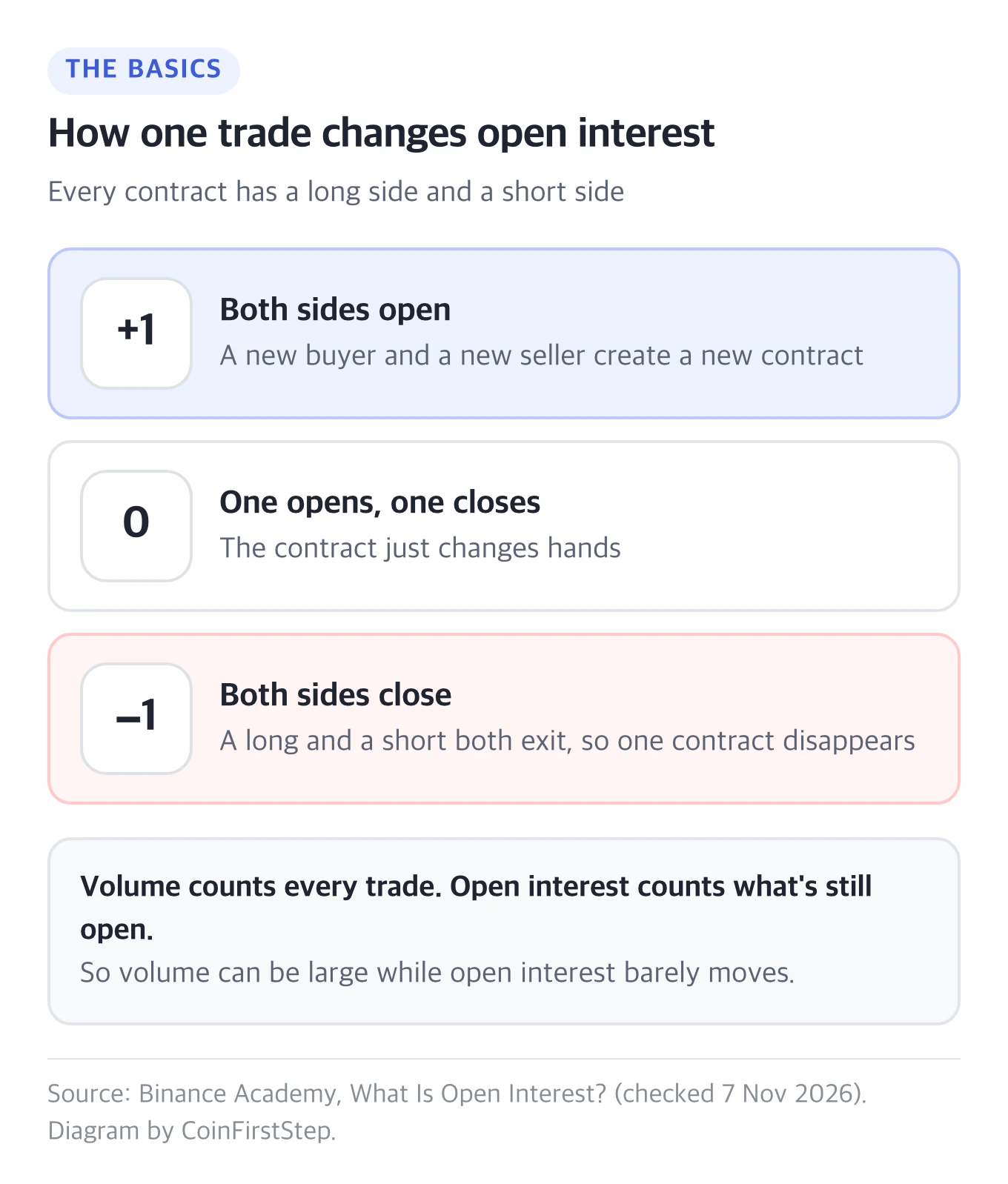
Whether a trade changes open interest depends on both sides. If a new buyer meets a new seller, a new contract appears. If one trader opens while the other closes, the contract just changes hands. If both close, a contract disappears.
2. Open interest vs volume
| Volume | Every trade in a period, opening or closing |
|---|---|
| Open interest | The contracts still open at one moment |
| One month of BTCUSDT | Volume was about 43 times the average open interest |
Over a month, volume is far larger than open interest. A busy day can have huge volume while open interest barely moves, if most trades just swap positions between traders or new and closing positions cancel out. Read the two together: volume shows how much trading happened, open interest shows how many positions stayed open afterwards. The ratio of 43 is for this contract in this month only; it changes from coin to coin and month to month.
3. Read the unit before you read the change
Open interest can be shown in coins (BTC) or in dollar value (USDT). On a falling market, these two can tell very different stories.
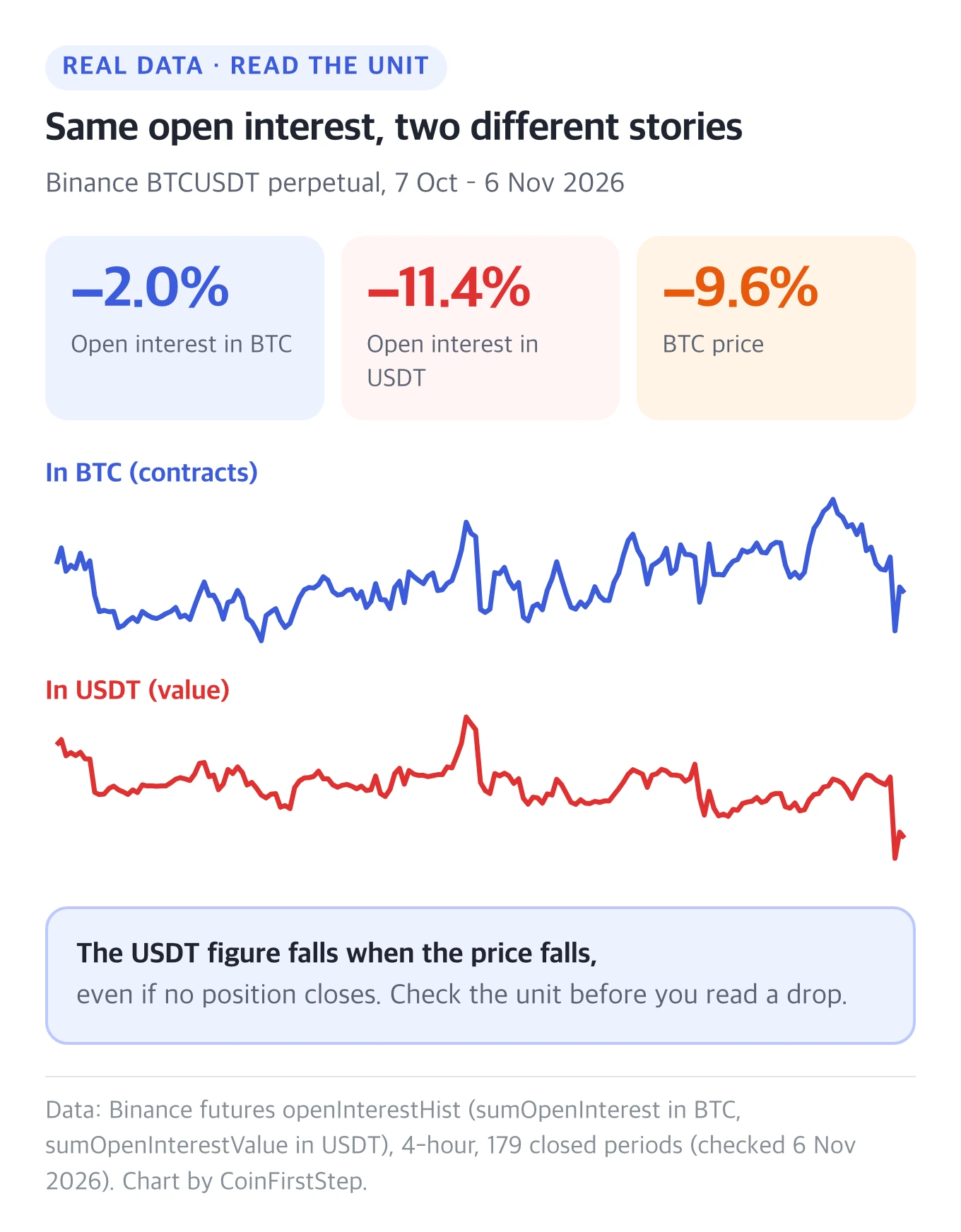
From 7 October 08:00 to 6 November 00:00 UTC, open interest in BTC fell only 2.0%, but in USDT it fell 11.4%. Most of the gap came from the price, which fell 9.6%. The dollar value of the same open contracts drops when the price drops, even if nobody closes a position. Binance's API gives both figures for every period, so check which one a chart uses before you read a drop as traders leaving.
4. Price and open interest: four cases
Many guides use a four-case table to read price and open interest together. It's a useful starting point, so here it is tested against the same month of data as in section 3, Read the unit before you read the change.
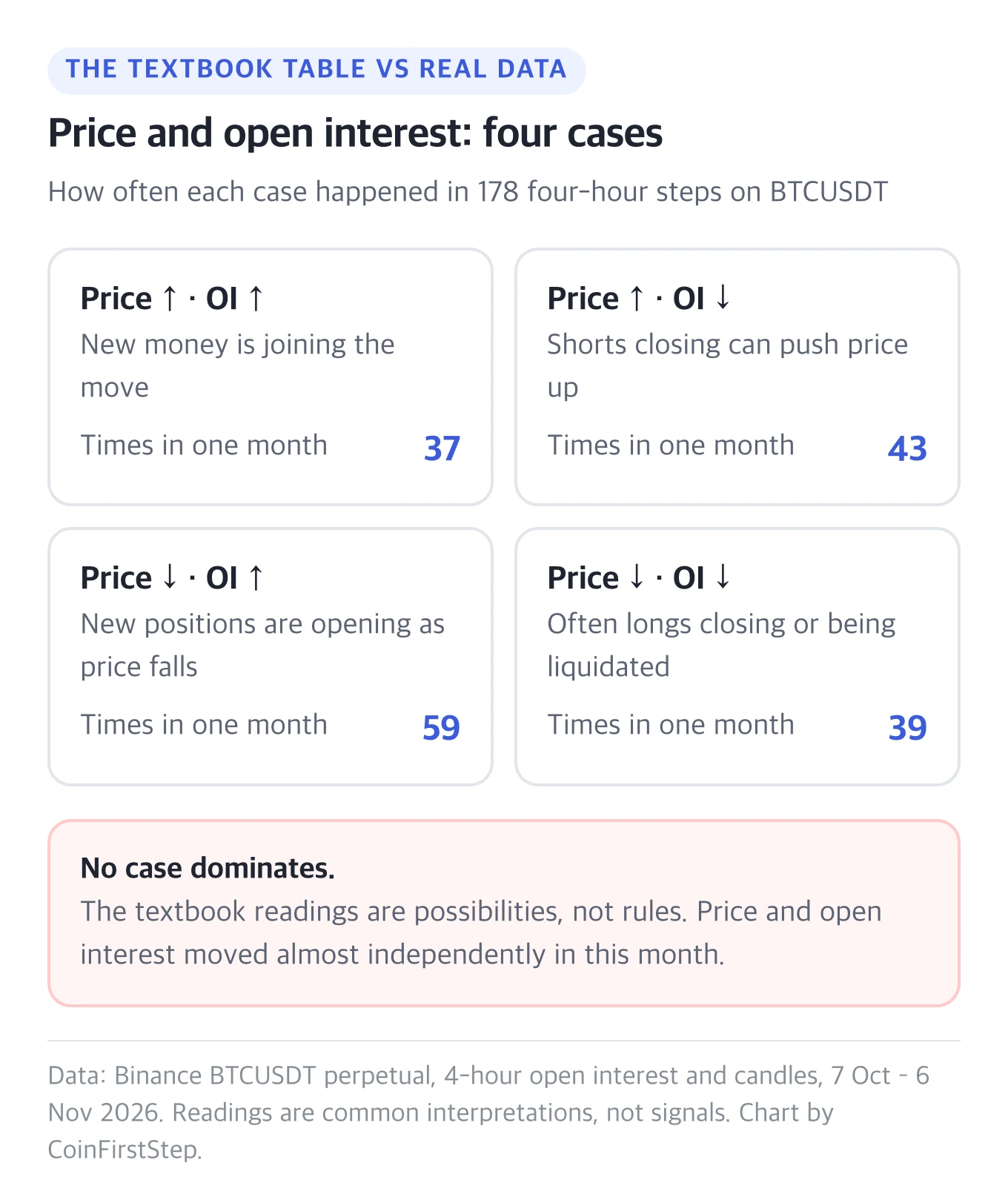
No case dominated. Across 178 four-hour steps, each case happened between 37 and 59 times, and the two moves were only weakly linked (a correlation of about 0.1). Use the four cases as questions to check, not as rules.
5. A real example on BTCUSDT
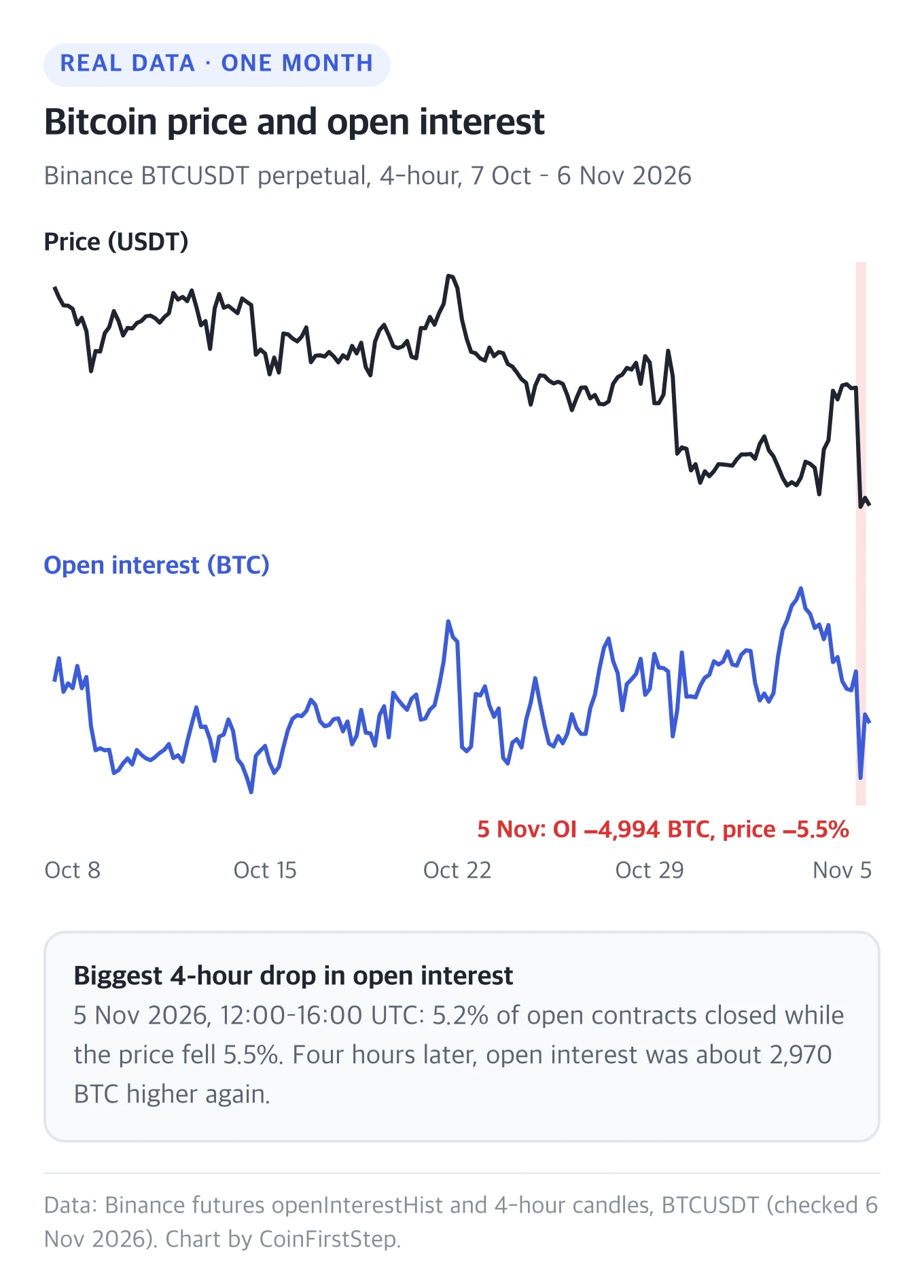
The biggest four-hour drop in open interest came on 5 November 2026, between 12:00 and 16:00 UTC. Open interest fell by about 4,994 BTC, 5.2% of the total, while the price fell 5.5% in the same window. A fall in price and open interest together can mean longs closing or being liquidated. The size of the price move doesn't always match, though: the second-biggest drop, on 22 October (00:00 to 04:00 UTC), was almost as large at about 4,944 BTC, but the price fell only 1.4%.
Four hours later, open interest was about 2,970 BTC higher again while the price stayed near the low. New positions opened right after the sharp drop.
When I see a drop like this, I check three things in order. In this example the answers were:
Is the drop in coins? Yes. It was 4,994 BTC, so positions really closed; it wasn't only the price shrinking the dollar value.
Was the funding rate high before the drop? No. BTCUSDT funding stayed at or below the 0.01% baseline in the day before the drop and never went higher during the whole month, so funding gave no sign that longs were unusually crowded. (See the funding rate guide for what the usual level means.)
Did open interest rebuild afterwards? Yes, by about 2,970 BTC in the next four hours.
Each answer narrows down what happened. None of the three answers tells you what the price does next, and this is one month of history for one contract.
6. Where to see open interest
| Binance Futures website | Data → Futures Data → Trading Data, for each contract |
|---|---|
| Binance API (openInterestHist) | History in BTC and USDT, but only for the latest month |
| Chart tools | Open interest under a price chart, often combined across exchanges |
As of November 2026, the Binance API only keeps about a month of open interest history, so for longer views you need other tools, and those often combine several exchanges. Read the source and the unit before you compare charts.
Open interest works best next to other data. The funding rate shows which side is paying to hold its position, and CVD shows who traded aggressively. If you're new to futures, how a first futures trade works on Binance explains positions step by step, and you'll need a verified account first: the step-by-step sign-up guide covers that.
Crypto prices are volatile, and futures with leverage can lose money quickly. This is an explainer, not investment advice.
7. Open interest in crypto FAQ
Is rising open interest bullish?
Not by itself. Every new contract has a long and a short, so rising open interest means more positions are open, not that buyers are winning. See section 4, Price and open interest: four cases.
What does falling open interest mean?
Positions are closing or being liquidated. Check the unit first: in dollar value, a falling price alone can also make it drop (section 3, Read the unit before you read the change).
Does open interest include spot trading?
No. Open interest exists only for derivatives such as futures and options, where contracts stay open until they're closed or settled.
Can open interest be higher than volume?
Yes, over a short period. Volume only counts trades in that period, while open interest is everything still open, including positions opened weeks ago. On BTCUSDT in the month used in section 3, Read the unit before you read the change, open interest was larger than four-hour volume in 177 of 179 periods, but larger than daily volume on only 6 of 29 days.
Why do different sites show different open interest?
They may use different exchanges, contracts or units. Some show one exchange in coins, others combine many exchanges in dollars.
That covers what open interest in crypto futures shows and how to read it.
Thanks for reading!